Symmetry
Line (reflective) symmetry
Look closely at a snowflake, a flower's petals, or the grand front of a cathedral and you spot
the same thing: the left half is a perfect mirror of the right. That balance is
symmetry, and we notice it everywhere — it's why a face drawn lopsided looks
"wrong", and why designers and builders reach for it to make things feel steady and pleasing.
A shape has a line of symmetry if you could fold it along
that line and the two halves would land exactly on top of each other — no
overhang, no gap. The fold line acts like a mirror: everything on one side is
reflected onto a perfect match on the other. This is also called reflective symmetry.
Try it in your head with a butterfly: fold it down the middle and the left
wing covers the right wing perfectly. That middle crease is its line of symmetry. A shape that
has at least one such line is called symmetrical.
Cut any shape out of paper and try to fold it so one half sits exactly on the other. If you
can, your fold is a line of symmetry — trace along the crease to draw it. If no fold
ever lines the halves up, the shape has no line of symmetry. A scrunched,
lopsided blob is the classic example: there is simply no fold that works.
How many lines? Some have several, some none
A shape can have more than one line of symmetry — or none at all. Counting them
is just asking: how many different folds line the halves up?
-
A square has 4 lines of symmetry: one through each
pair of opposite edges (up–down and left–right), and one along each diagonal.
-
A rectangle (that is not a square) has only 2 —
the up–down fold and the left–right fold. (Its diagonals do not work; see below.)
-
An equilateral triangle
has 3, an isosceles triangle has just
1, and a scalene triangle (all sides different)
has 0.
-
A circle has infinitely many — every line through its centre
folds it perfectly.
In general a
regular
n-gon has exactly n lines of symmetry: a
regular pentagon has 5, a regular hexagon has
6, and so on.
 A regular five-pointed star has 5 lines of
symmetry — one straight down through each point to the dip between the two opposite points.
Fold along any of those five lines and the star matches itself exactly. (A six-pointed star
would have 6.)
A regular five-pointed star has 5 lines of
symmetry — one straight down through each point to the dip between the two opposite points.
Fold along any of those five lines and the star matches itself exactly. (A six-pointed star
would have 6.)
Worked examples
A square. Fold the top down onto the bottom — they match: that is one line.
Fold the left onto the right — match: a second. Now fold corner-to-corner along a diagonal — the
two triangles match: a third. The other diagonal gives a fourth. No other fold works, so a
square has exactly 4 lines of symmetry.
The letter A. Fold it left-to-right down the middle and the two slanted legs
swap places perfectly: 1 line of symmetry. Fold it top-to-bottom and
the pointed top does not match the open legs, so there is no horizontal line.
A rectangle. Up–down works, left–right works — that is
2. Tempting as it looks, a diagonal fold does not match the
halves (a long thin rectangle folded corner-to-corner spills over the edge). So a non-square
rectangle has exactly 2 lines, not 4.
-
A diagonal is not always a line of symmetry. It is for a square, but for a
rectangle the diagonal fold fails — the halves do not land on each
other. Always check by folding, never assume.
-
"Cutting into two equal halves" is not enough. A line can split a shape into
two pieces of equal area yet the pieces still not be mirror images. A line of
symmetry needs the halves to be reflections of each other.
See the lines
Step through the figure: first a square with its four mirror lines, then an equilateral
triangle with its three, and finally the rotational order of each.
Rotational symmetry
There is a second kind of symmetry. A shape has rotational symmetry if you can
turn it about its centre by less
than a full turn and it looks exactly the same as before. The
order m counts how many times the shape matches
itself during one complete 360^\circ turn.
A square has rotational symmetry of order
4 — it looks the same after every
90^\circ — and an equilateral triangle has
order 3, matching after every
120^\circ. A regular n-gon has
rotational symmetry of order n. A shape can have
rotational symmetry with no line of symmetry at all — a pinwheel or a recycling logo
spins onto itself but cannot be folded to match.
-
line (reflective) symmetry — a fold line that maps the shape exactly onto
itself;
-
rotational symmetry — how many times a turn maps the shape onto itself in
one full 360^\circ (its order);
-
a regular n-gon has
n lines of symmetry and rotational symmetry of
order n.
Symmetry in letters and in nature
Symmetry is everywhere once you look. Many capital letters have a line of
symmetry: A, M, T, U, V, W, Y have a vertical one; B, C, D, E, K
have a horizontal one; and H, I, O, X have both. The letters
F, G, J, L, P, Q, R have none.
Nature loves the mirror too. A butterfly, a leaf, a snowflake (which has
6 lines), and an animal's face all show line symmetry — the left side
mirrors the right.
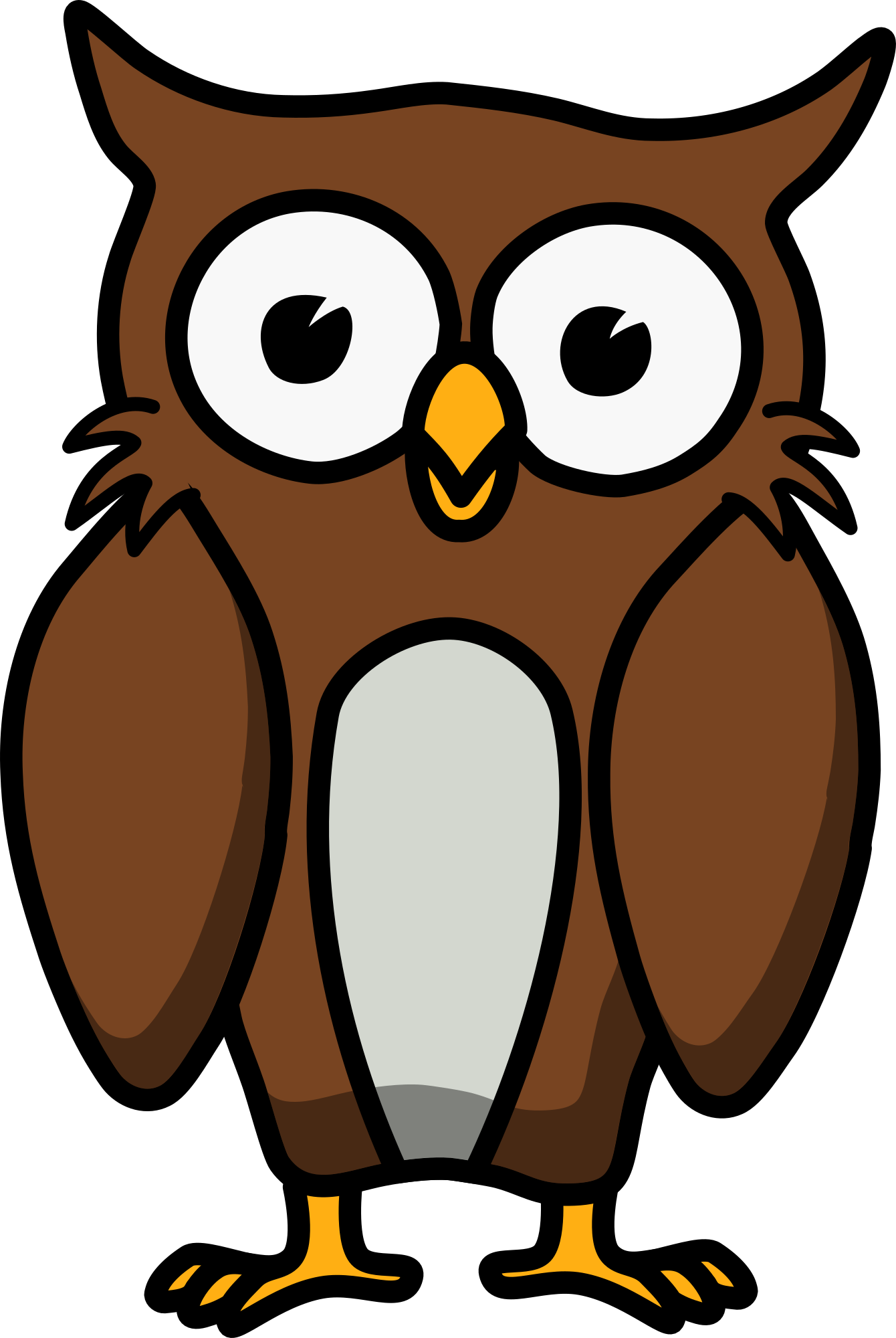 Look at this owl head-on. Draw a line straight down the middle — between the eyes, down the
beak — and the left half mirrors the right: one eye on each side, one ear-tuft on each side.
That single vertical fold is its line of symmetry. Almost every animal face works this way,
which is why a face drawn lopsided looks "wrong".
Look at this owl head-on. Draw a line straight down the middle — between the eyes, down the
beak — and the left half mirrors the right: one eye on each side, one ear-tuft on each side.
That single vertical fold is its line of symmetry. Almost every animal face works this way,
which is why a face drawn lopsided looks "wrong".
Spot the lines yourself
Here is a fresh example each time. A random shape or letter appears with every line of symmetry
drawn as a dashed mirror line — fold along any dashed line and the two halves match. Some shapes
show several lines; a few show none. Press Refresh for a new
one.