Reflection
A reflection flips a shape across a mirror line — exactly like the
image you see in a still pond or a flat mirror. The mirror line is the fold: imagine folding
the paper along it, and the shape would land perfectly on top of its image.
Each point maps to a new point the same distance on the other side
of the mirror line, measured straight across (at a right angle to the
mirror). So the mirror line is the perpendicular bisector of every little
segment joining a point to its image — it cuts that segment exactly in half, square on.
The image keeps its size and its angles, but its
orientation is reversed: it is a mirror image, as if you had
turned the shape over. Lengths and angles never change — only the handedness flips, so left
becomes right.
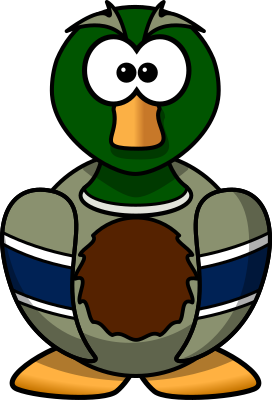 A duck sitting on calm water sees an upside-down twin staring back. The waterline is the
mirror line: every feather of the reflection is the same distance below the water
as the real feather is above it. That is reflection in nature — the same flip we
draw on a grid.
A duck sitting on calm water sees an upside-down twin staring back. The waterline is the
mirror line: every feather of the reflection is the same distance below the water
as the real feather is above it. That is reflection in nature — the same flip we
draw on a grid.
Same distance, other side
Here is the one rule that powers every reflection: pick any corner of your shape, hop
straight across the mirror at a right angle, and travel the same distance
you started with. That is where the corner's image lands. Do it for every corner and join
them up — you have the reflected shape.
Two traps to dodge:
- Each point stays the same distance from the mirror — just on the
other side. A point sitting on the mirror line does not move at
all (zero distance across).
- A reflection flips the shape (left ↔ right); it does
not slide it. Sliding without flipping is a different move (a
translation) and gives the wrong picture.
Reflection in coordinates
On a grid, reflecting in the common mirror lines is just a sign-swap or a swap of
coordinates:
- in the x-axis: (x, y) \mapsto (x, -y)
(the across-distance is the height y, so flip its sign);
- in the y-axis: (x, y) \mapsto (-x, y);
- in the line y = x: (x, y) \mapsto (y, x)
(swap the two coordinates).
Worked examples
Reflecting is the same little hop every time. Three to follow:
- Reflect (3, 2) in the x-axis: keep
x = 3, flip the height to get
(3, -2). It is now 2 below the axis
instead of 2 above — same distance, other side.
- Reflect the triangle with corners (1, 1),
(4, 1), (1, 3) in the
y-axis: each x changes sign, giving
(-1, 1), (-4, 1),
(-1, 3) — same size, flipped left to right.
- Reflect (5, 2) in the vertical line
x = 3: the point is 2 to the right of
the mirror, so the image sits 2 to the left, at
(1, 2).
Seeing it on a grid
Take the triangle with vertices (1, 1),
(3, 1) and (1, 4), and reflect it in
the line y = x. Step through the figure: each vertex swaps its
coordinates, so the image has vertices (1, 1),
(1, 3) and (4, 1) — same size, same
angles, reversed orientation.
Try it yourself
Here is a random shape (blue) and its mirror image (orange) across a dashed mirror line. One
corner is marked A and its image A',
joined by a faint line that crosses the mirror at a right angle — and is cut exactly in half
by it. Notice the image is the same size but flipped. Press Refresh
for a new one.
 Draw a line straight down the middle of an owl and the left half is the mirror image of the
right half — same eye, same wing, flipped across. Butterflies, faces and leaves do it too.
We say such a shape has line symmetry: it is its own reflection in that
middle mirror line.
Draw a line straight down the middle of an owl and the left half is the mirror image of the
right half — same eye, same wing, flipped across. Butterflies, faces and leaves do it too.
We say such a shape has line symmetry: it is its own reflection in that
middle mirror line.
See it explained