Naming Simple Shapes
Look around the room. A window is one shape. A clock on the wall is another. A slice of pizza,
cut on the diagonal, is another shape again. Every one of these has a name —
and today you are going to learn four of them: circle,
triangle, square and rectangle.
To name a flat shape we look at two things: its sides — the straight edges you
could trace with your finger — and its corners — the pointy bits where two
sides bump into each other. You already know how to
count, so
counting sides and corners is easy — that count is what gives each shape its name.
Triangle: three sides, three corners
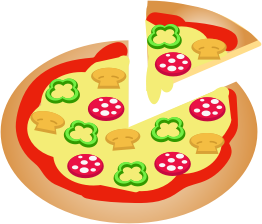
Cut a piece of toast across the middle, corner to corner, and one half makes a
triangle. So does a slice of pizza, and so does a road sign that warns
"danger ahead". A triangle always has exactly 3 straight sides and
3 corners — never more, never fewer. Trace one with your finger: side, corner,
side, corner, side, corner. Three of each.
Square and rectangle: four sides, four corners
A door is a shape with 4 straight sides and 4 corners, and
every one of its corners is a neat, square corner — like the corner of a book. That makes it a
rectangle. Look closely, though: two of its sides are long and two are short.
A square is a rectangle's tidier cousin. It also has 4 straight sides and 4
square corners — but a square's sides are all exactly the same length. A window
pane that is just as tall as it is wide is a square; a door, taller than it is wide, is a
rectangle. Same number of sides and corners, but look at the lengths to tell them apart.
Not because it's small — because all four of its sides match. You could draw
a giant square bigger than a tiny rectangle, and it would still be a square. The difference
between a square and a rectangle is never about size — it's about whether all four sides are
the same length (square) or come in two long sides and two short sides (rectangle).
Circle: the round one
A clock face is round. So is a wheel, a coin, and the biscuit on a plate. A
circle is the odd one out of our four shapes: it is one smooth, curved line
with no straight sides at all and no corners to trace. Run
your finger round a circle and it never once changes direction sharply — it just keeps curving.
That is exactly why wheels are round and not square: a circle has no corners to bump and judder
over, so it rolls along smoothly.
The shape gallery
Step through the gallery below to meet all four shapes, one at a time. Read the caption under
each one, then count its sides and corners for yourself before you move on.
Name that shape
Before you press Refresh, say the shape's name out loud — is it a circle, a triangle, a square
or a rectangle? Then check yourself against the label.
Size and colour never change a shape's name. A tiny red triangle and a huge
blue triangle are both still triangles — what matters is the count of straight sides and
corners, not how big the shape is or what colour it's coloured in. And remember: a square and
a rectangle both have 4 sides and 4 corners — don't tell them apart by size, tell them apart by
whether all four sides match (square) or only the opposite pairs match (rectangle).
One day you'll meet shapes with even more sides — five, six, eight — and learn their proper
family names, like "polygon" and "quadrilateral", in
Naming 2D Shapes.
For now, these four shapes — circle, triangle, square and rectangle — are the ones to know by
heart. Spot them on your walk home: windows, wheels, road signs, doors. They are everywhere.
See it explained