Naming 3D Shapes
Flat shapes and solid shapes
A flat shape — a
square, a circle, a triangle — is 2D: it has length and width, but no
thickness. You could draw it on paper. A solid shape is
3D: it takes up space and has length, width and height. You can
hold it in your hand. A ball, a box, a tin of beans and an ice-cream cone are all solids.
We describe every solid with three things:
- Faces — the surfaces of the solid. A face can be flat (like
the side of a box) or curved (like the round side of a ball).
- Edges — the lines where two faces meet.
- Vertices — the corners, where edges meet (one corner is a
vertex; two or more are vertices).
Count those three things and you can name almost any everyday solid. Notice that a solid's
flat faces are just 2D shapes: the faces of a box are rectangles, and the faces of a cube are
squares. A 3D shape is built out of 2D shapes.
The everyday solids
Here is each common solid, the 2D faces it is built from, and where you see it in real life:
- A cube has 6 square faces, all the same size — like a
dice or a sugar cube. (12 edges, 8 vertices.)
- A cuboid (a box) has 6 rectangular faces — like a cereal
box or a brick. (12 edges, 8 vertices.)
- A sphere (a ball) has 1 curved surface — no flat faces,
no edges and no vertices. A football, a marble and the Earth are spheres.
- A cylinder (a tin) has 2 flat circles (top and bottom)
and 1 curved face wrapped round the middle — like a tin of beans or a can
of drink. (2 curved edges, 0 vertices.)
- A cone has 1 flat circle and 1 curved face
rising to a single point — like an ice-cream cone or a party hat. (1 edge, 1 vertex.)
- A square-based pyramid has a square base and
4 triangular faces meeting at a point on top — like the pyramids of Egypt.
(8 edges, 5 vertices.)
- A triangular prism has 2 triangular ends and
3 rectangular faces — like a toblerone bar or a tent. (9 edges, 6 vertices.)
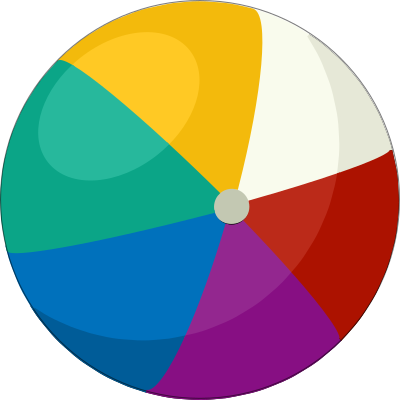


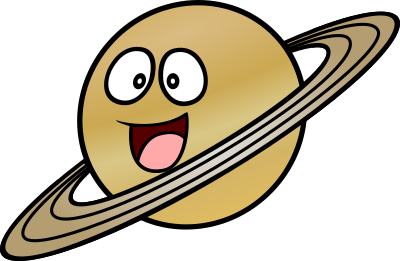
A football, the Earth, the Sun and the planets are all spheres — a sphere
is the perfectly round solid. It has just one smooth, curved surface: run your finger over a
ball and you never meet an edge or a corner. (Saturn looks pointy because of its flat rings,
but the planet itself is a sphere.) That is why spheres roll so well in every direction —
there is no flat face to stop them.
A gallery of solids
Step through the sketches. Each is a flat drawing of a 3D solid — a front shape, an offset
back shape, and lines joining them to give the "3D" look. As you go, name the 2D faces you
can see: squares on the cube, rectangles on the cuboid, circles on the cylinder and cone.
Turn a solid in your hands
Every 3D solid is built from faces (flat surfaces), edges (where
faces meet) and vertices (corners). Here is a real square-based
pyramid you can spin: it has 5 faces (1 square base + 4 triangles),
8 edges and 5 vertices. Drag to rotate it and count them for
yourself.
Count it yourself
Here is one solid at a time, with its faces, edges and vertices counted underneath. Cover the
numbers, guess them, then check. Press Refresh for a new solid.
Worked examples
Example 1 — a cereal box. A box is a cuboid. Its surfaces
are 6 rectangles (front and back, left and right, top and bottom), so it has
6 faces. The rectangles meet along 12 edges, and the edges
meet at 8 corners, so 8 vertices.
Example 2 — a tin of beans. A tin is a cylinder. The flat
lid and flat base are 2 circles, and the curved label wrapped round is 1 face — so
3 faces. The two circle rims are its 2 edges, and because it
is smooth and round it has no corners: 0 vertices.
Example 3 — an ice-cream cone. A cone has a flat circle and one curved face
that rises to a point — 2 faces. The circle rim is its single edge
(1 edge), and the sharp point on top is its single corner
(1 vertex).
What the words mean
- Faces are the surfaces of a solid (flat or curved).
- Edges are the lines where two faces meet.
- Vertices are the corners.
- A cube has 6 faces, 12 edges and 8 vertices.
- A prism has the same cross-section all the way through — if you sliced it
anywhere along its length, every slice would look the same shape.
- A pyramid has a flat base and rises to a single point.
The two traps when naming solids:
- A square is flat (2D); a cube is solid (3D). Don't mix
the names — a dice is a cube, not a "square". The same goes for a
circle (flat) and a sphere (a ball), and a triangle (flat) and
a pyramid (solid).
- Faces, edges and vertices are different things. A face is a whole
surface, an edge is a line, a vertex is a single point. "How many faces?" and "how many
corners?" usually have different answers — a cube has 6 faces but 8 corners.
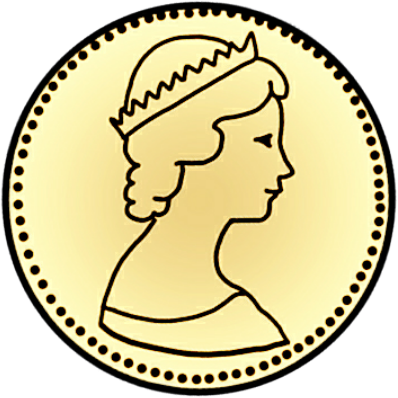

Naming solids is really a game of "what does it look like?". A coin is a
very short cylinder — two flat circle faces with a thin curved edge. A
ball is a sphere. A bus is roughly a
cuboid — a long box with 6 flat sides. Once you can spot the solid behind
an object, you can count its faces, edges and vertices straight away.