Every time you open a door, tip a seesaw, or read the hands of a clock, you are looking at an
angle — a measure of how far something has turned. Learning to measure angles
lets you say exactly how wide a corner or a turn is, instead of just “a little” or
“a lot”.
An angle is the amount of turn between two
rays that start
from the same point. That shared point is the vertex, and the two rays are
the arms of the angle. Keep one arm still and swing the other: the further
you swing it, the wider the opening — and the bigger the angle.
An angle is about turning, not distance. It does not matter how long you draw the
arms — a short pair of arms and a long pair of arms can hold exactly the same angle. What we
measure is how much one arm has spun away from the other.
We measure that turn in degrees, written with a little circle:
^\circ. One full spin all the way around — back to where you
started — is 360°. From there, every other angle is a fraction of a full
turn:
- a full turn (once around) is 360^\circ;
- a half turn (a straight angle) is 180^\circ;
-
a quarter turn (a right angle) is 90^\circ —
the square corner, marked with a small square instead of an arc;
- a three-quarter turn is 270^\circ.
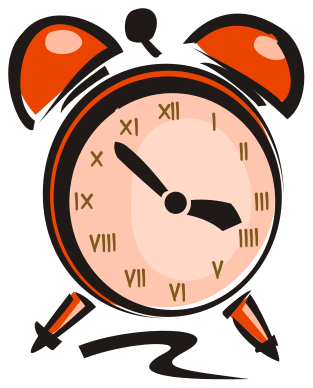
The two hands of a clock meet at the centre — that is the vertex — and
the hands are the arms. At 3 o'clock the hands make a
neat square corner: a 90^\circ right angle. At
6 o'clock they point opposite ways and lie flat — a
180^\circ straight angle. At 12 o'clock the
hands sit on top of each other, so the angle is 0^\circ: no turn
at all. Watch the hands all day and you will see every angle there is.
Drag the slider to swing the second arm around the vertex. Watch the reading climb from a
thin sliver, through the right angle and the straight angle, all the way to a full turn.
Naming angles by size
Once you can measure an angle, you can sort it into a family by how big it is:
- Acute — smaller than a right angle: less than 90^\circ.
- Right — exactly 90^\circ (the square corner).
- Obtuse — between 90^\circ and 180^\circ.
- Straight — exactly 180^\circ, a flat half turn.
- Reflex — bigger than a straight angle: more than 180^\circ (but less than a full 360^\circ).
A quick way to remember the first two: an a-cute little angle is small and
sharp, while an obtuse angle is big and blunt. Step through one of each below.

The pointy tip of a pizza slice is a vertex, and the two straight cuts are
the arms. A thin, mean little slice has a small, acute
angle. If you are hungrier and cut a fat slice — more than a square corner's worth — the tip
opens up into an obtuse angle. Cut the whole pizza into eight equal slices
and each tip is a 45^\circ angle, because
360^\circ \div 8 = 45^\circ.