Angles on a Line and at a Point
Look at the spokes fanning out from the hub of a bike wheel, or the roads meeting at a
roundabout — the angles packed around that centre point always fill one full turn. This tidy
behaviour lets builders, designers and game-makers pin down a missing angle with simple
arithmetic, no protractor needed.
Angles fit together in tidy ways. When several angles sit side by side along a
straight line, they always add up to 180^\circ — a
straight line is a "half turn". When angles meet all the way around a point,
filling a full turn, they add up to 360^\circ. And when two straight
lines cross, the angles facing each other — the vertically opposite
ones — are always equal.
\text{on a line} = 180^\circ \qquad \text{around a point} = 360^\circ
These facts let you find a missing angle by subtraction — no protractor needed. They build on
measuring angles in degrees.
Three facts about angles that share a vertex:
-
angles on a straight line add up to 180^\circ —
if a and b lie on a line then
a + b = 180^\circ;
-
angles all the way around a point add up to
360^\circ — if x,
y and z fill the turn then
x + y + z = 360^\circ;
-
where two straight lines cross, vertically opposite angles are
equal.
Why it works
A straight line is half of a full turn, and a full turn around a point is everything. Step through
both pictures.
So whenever angles sit on a line, fill in the missing one with 180^\circ - (\text{the rest});
around a point, use 360^\circ - (\text{the rest}).
Crossing lines: vertically opposite angles
When two straight lines cross they make four angles. Going around the crossing you meet them in the
order a, b, a,
b: the two angles that sit across the X from each other
are always equal. They are called vertically opposite angles.
Why? Each a and the b next to it sit on a
straight line, so a + b = 180^\circ. The same is true on the other side,
so the two a's must match — they are both
180^\circ - b. See the dedicated page on
vertically opposite angles
for more.
Three worked examples
1. Two angles on a line. A straight line is split into one angle of
110^\circ and one unknown angle. Since they sit on a line:
? = 180^\circ - 110^\circ = 70^\circ
2. Angles around a point. Three angles meet at a point:
90^\circ, 150^\circ and one more, filling the
full turn. They must total 360^\circ:
? = 360^\circ - 90^\circ - 150^\circ = 120^\circ
3. Crossing lines. Two lines cross and one angle is
65^\circ. The angle next to it on a straight line is
180^\circ - 65^\circ = 115^\circ, and the angle opposite the
65^\circ is equal to it:
\text{opposite} = 65^\circ, \qquad \text{neighbour} = 115^\circ
 Cut a round pizza into slices and every slice meets at the centre point. The tip
angles of all the slices go the whole way around that point, so they add up to
360^\circ. Eight equal slices? Each tip is
360^\circ \div 8 = 45^\circ.
Cut a round pizza into slices and every slice meets at the centre point. The tip
angles of all the slices go the whole way around that point, so they add up to
360^\circ. Eight equal slices? Each tip is
360^\circ \div 8 = 45^\circ.
Your turn: find the missing angle
The figure below shows a fresh fan of angles each time. Sometimes they sit on a
straight line (total 180^\circ); sometimes they go all
the way around a point (total 360^\circ). Read the line
at the bottom to see which, add up the angles you are given, and subtract from the total to find the
one marked ?. Press Refresh for a new one.
Always check which total you need first:
- angles on a LINE make 180^\circ;
- angles AROUND a point make 360^\circ.
Using 360^\circ when the angles are really on a line (or vice versa) is
the classic mistake. And the rule only works when the angles truly
meet at the same point or sit on the same line — angles scattered in different
places don't add up to anything special.
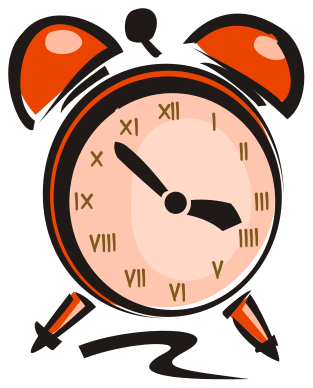 The twelve hour marks on a clock split the full turn around the centre into twelve equal angles, so
each is 360^\circ \div 12 = 30^\circ. And when the hands point straight
up and straight down (12 and 6) they make a straight line:
180^\circ.
The twelve hour marks on a clock split the full turn around the centre into twelve equal angles, so
each is 360^\circ \div 12 = 30^\circ. And when the hands point straight
up and straight down (12 and 6) they make a straight line:
180^\circ.
Practise: chase the angles
Two lines cross at a point. Fill in every angle you can — using angles on a straight
line — ending with the highlighted one. Refresh for a new figure;
Check explains each step.