Skip Counting
Imagine you're setting the table and every person needs 2 forks. Instead of
pointing at each fork one by one, you can count the people in twos — 2, 4, 6, 8 — and know the
forks in a flash. Counting socks by twos, shoes by twos, or biscuits shared 5 to a plate all
work the same happy way.
Skip counting means counting in equal jumps — by
2s, 5s or
10s — instead of one at a time. Each jump skips over the numbers in
between and adds a whole group at once, so you reach big numbers fast.
Counting by ones to get to thirty takes thirty little steps. Counting by tens gets there in just
three: 10, 20, 30. Counting by fives takes six: 5, 10, 15, 20, 25, 30. Same
destination, far fewer hops.
Press play: a marker hops along the number line in equal steps, a little school of fish
appears for every jump, and we say each number we land on. Those landing numbers
(2, 4, 6, \dots) are exactly the ones that make
multiplication quick.
Every jump is a whole group
Here is the big idea: a skip-count jump does not add one — it adds an entire group.
When you count by 5s, every hop drops in another group of five. After three
hops you have counted three groups of five:
5 + 5 + 5 = 15 \quad=\quad 3 \times 5
Grown-ups have a name for adding the same group over and over — multiplication —
and skip counting is the very start of it, along with your times tables, which
you'll meet properly soon. For now, just notice: the numbers you say when you skip count
are the answers in a times table:
- Count by 2s: 2, 4, 6, 8, 10\dots — that's the
2 times table.
- Count by 5s: 5, 10, 15, 20, 25\dots — the
5 times table.
- Count by 10s: 10, 20, 30, 40\dots — the
10 times table.
Three worked examples
Counting by 2s. Start at 0 and add two each time:
0 \xrightarrow{+2} 2 \xrightarrow{+2} 4 \xrightarrow{+2} 6 \xrightarrow{+2} 8
Four jumps of two land you on 8, because
4 \times 2 = 8.
Counting by 5s. Each hop adds five:
0 \xrightarrow{+5} 5 \xrightarrow{+5} 10 \xrightarrow{+5} 15 \xrightarrow{+5} 20
Four jumps of five reach 20 = 4 \times 5.
Counting by 3s. Threes are trickier because they don't end in a tidy digit, but the
rule is the same — add three each time:
0 \xrightarrow{+3} 3 \xrightarrow{+3} 6 \xrightarrow{+3} 9 \xrightarrow{+3} 12
Four jumps of three reach 12 = 4 \times 3.
Spot the pattern in the last digit
Skip counting leaves a tidy trail in the last digit (the ones digit). Once you spot
it you can keep going forever without doing any sums:
- Count by 10s and the last digit is always 0:
10, 20, 30, 40, 50\dots
- Count by 5s and the last digit flips back and forth,
5, 0, 5, 0\dots:
5, 1\underline{0}, 1\underline{5}, 2\underline{0}, 2\underline{5}\dots
- Count by 2s from zero and you only ever land on
even numbers, ending in 0, 2, 4, 6, 8.
Two things to keep straight when you skip count:
- Every jump must be the SAME size. If you count
5, 10, 15, 21 you have changed the jump partway through — that is no
longer counting by fives. Keep adding the very same number each time.
- Counting in 5s, the ones digit does not stay the
same — it alternates 5, 0, 5, 0:
5, 10, 15, 20, 25, 30. Only the tens step up steadily.
Skip counting is everywhere
Lots of real things come in fixed-size groups, so skip counting is the fast way to count them.
Every duck has 2 feet. So to count the feet in a row of ducks you don't count one
foot at a time — you skip count in twos, one jump per duck:
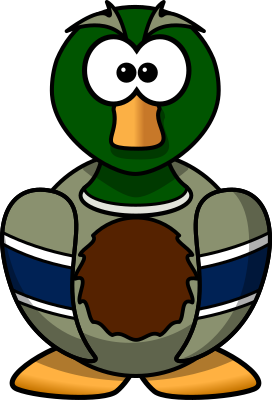
Four ducks: 2, 4, 6, 8 — 8 feet altogether, and that is
just 4 \times 2.
Every car has 4 wheels. To count the wheels in a car park you skip count in fours,
one jump per car:
Three cars: 4, 8, 12 — 12 wheels, which is
3 \times 4. Counting them one wheel at a time would take twelve steps;
skip counting takes three.
See it: a jumping number line
Step through the jumps below. The marker starts at 0 and arcs forward by an
equal jump each time, landing only on the multiples. Press Refresh for a new jump
size — sometimes 2s, sometimes 5s, sometimes
10s — and watch the landing numbers change.
Khan Academy shows skip counting here: