"Five more minutes!" "Is it lunchtime yet?" "When does the bus come?" All day long we want to know what time it is — and the round clock on the wall can tell us, once we know how to read it. It looks tricky at first because two pointers, called hands, are moving at once. But each hand has just one job, and once you know the jobs you can read any clock in the world.
A clock has the numbers 1 to 12 spaced evenly around its face, and the two hands point at them:
- the short, fat hand shows the hour — what o'clock it is;
- the long, thin hand shows the minutes — how far into the hour we are.
Read the short hand first to find the hour, then the long hand to find the minutes. There are four positions of the long hand that are so handy they have their own names:
- long hand straight up on 12 → o'clock (a brand-new hour);
- long hand on 3 (a quarter of the way round) → quarter past;
- long hand on 6 (halfway round) → half past;
- long hand on 9 (three quarters round) → quarter to.
And here is the magic counting rule: each number the long hand passes is 5 minutes.
So the long hand on 1 means 5 minutes past, on 2 means 10 minutes past, on 3 means 15 minutes
(a quarter past), and so on. Going all the way round the 12 numbers is
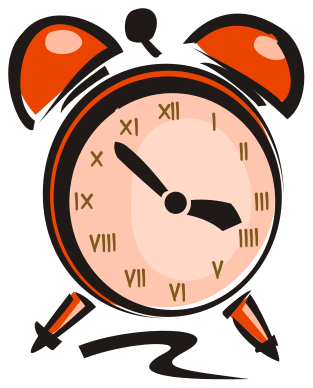 Watch them for a whole hour. The long hand zooms all the way around the face — one
complete lap — while the short hand creeps from one number to just the next
one. In the time the long hand does a full circle, the short hand covers only one twelfth of the
face. So the long hand is moving twelve times faster! That is why the minutes (long
hand) change quickly and the hour (short hand) changes slowly. If you ever catch the short hand
sitting exactly between two numbers, that is your clue that the long hand is somewhere near the
bottom — it is half past.
Watch them for a whole hour. The long hand zooms all the way around the face — one
complete lap — while the short hand creeps from one number to just the next
one. In the time the long hand does a full circle, the short hand covers only one twelfth of the
face. So the long hand is moving twelve times faster! That is why the minutes (long
hand) change quickly and the hour (short hand) changes slowly. If you ever catch the short hand
sitting exactly between two numbers, that is your clue that the long hand is somewhere near the
bottom — it is half past.

 The short hand goes round the clock only once every 12 hours, but a day is 24 hours
long — so it makes two trips. That means 3 o'clock comes round in the afternoon when the
sun is up, and again in the middle of the night when the owl is awake.
To tell them apart, grown-ups say 3 in the morning (am) or 3 in the afternoon
(pm). Same hands, same clock — the sun and the owl tell you which one we mean.
The short hand goes round the clock only once every 12 hours, but a day is 24 hours
long — so it makes two trips. That means 3 o'clock comes round in the afternoon when the
sun is up, and again in the middle of the night when the owl is awake.
To tell them apart, grown-ups say 3 in the morning (am) or 3 in the afternoon
(pm). Same hands, same clock — the sun and the owl tell you which one we mean.