Money and Giving Change
You take a \pounds 5 note to the shop to buy a comic, and the
shopkeeper hands you some coins back. Working out whether that change is right — and counting
up your own coins in the first place — is exactly what this page is about.
Money is made of coins and notes. In Britain we count in
pounds and pence. There are exactly
100 pence in a pound, so \pounds 1 = 100\text{ p} —
just like there are 100 little cubes in a hundred-square.
The coins you can hold are 1p, 2p, 5p, 10p, 20p, 50p, £1 and £2; the paper
(and plastic) notes are £5, £10, £20 and £50. Every price is just a pile of
these put together. An amount like \pounds 3.45 means
3 pounds and 45 pence — the two digits after the point always count the pence.
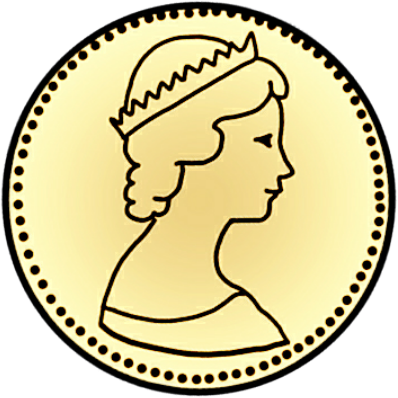 Most coins are round, but the 50p and 20p have flat-ish sides so a blind person — or a
vending machine — can tell them apart by feel. Clever! Coins come in handy sizes too: small
ones are worth little, big ones are worth more. Long ago people really did pay with chunks
of silver and gold; today the coin just stands for that value. Collect the right
coins and you can make any amount of money.
Most coins are round, but the 50p and 20p have flat-ish sides so a blind person — or a
vending machine — can tell them apart by feel. Clever! Coins come in handy sizes too: small
ones are worth little, big ones are worth more. Long ago people really did pay with chunks
of silver and gold; today the coin just stands for that value. Collect the right
coins and you can make any amount of money.
Making a total from coins
To find out how much money you have, add up the coins. Suppose your purse
holds a 50p, two 20p coins and a 10p:
50\text{ p} + 20\text{ p} + 20\text{ p} + 10\text{ p} = 100\text{ p} = \pounds 1
Four coins, but together they make one whole pound. A good trick is to start with the
biggest coin and count on: "50… 70… 90… 100." When the pence reach 100, swap them for
a £1 — exactly like trading ten ones for a ten in
place value.
Adding amounts of money
Because money uses two decimal places, you add and subtract amounts of money just like any
other
decimals:
line up the decimal points (pounds under pounds, pence under pence), then
work column by column from the right. For example, \pounds 2.30 + \pounds 1.45:
   2.30
 + 1.45
 ------
   3.75
So \pounds 2.30 + \pounds 1.45 = \pounds 3.75. The decimal points
stand in a tidy line, one under the other, so the points in the answer line up too.

 An apple costs \pounds 0.35 and a slice of cake costs
\pounds 1.20. Buy both and you line up the points:
\pounds 0.35 + \pounds 1.20 = \pounds 1.55. Notice the apple has
no whole pounds, so we still write the 0 in front of the point —
it keeps the pence in the right two columns, just like the 0 in place value holds a column
open.
An apple costs \pounds 0.35 and a slice of cake costs
\pounds 1.20. Buy both and you line up the points:
\pounds 0.35 + \pounds 1.20 = \pounds 1.55. Notice the apple has
no whole pounds, so we still write the 0 in front of the point —
it keeps the pence in the right two columns, just like the 0 in place value holds a column
open.
Giving change by counting up
When you pay with more money than something costs, the shopkeeper gives you back the
difference. That is your change:
\text{change} = \text{amount paid} - \text{price}
You can subtract, but the easiest way is to count up from the price to the
cash you handed over, in friendly hops, and add the hops together. A toy costs
\pounds 6.40 and you pay with a \pounds 10 note:
- From \pounds 6.40, hop 60 p up to a round
\pounds 7.
- Then hop £3 more, up to \pounds 10.
- Add the hops: 60\text{ p} + \pounds 3 = \pounds 3.60 change.
The picture below is a number line: it shows the little hop up to the next
whole pound, then the big pound-sized hops to the money you paid. Press Refresh
for a brand-new shopping trip.
Here is a smaller one you can do in your head. A rubber costs
30\text{ p} and you pay with a 50\text{ p}
coin. Count up from 30: "40… 50" — that is two hops of 10 p, so your change is
20\text{ p}. You never have to take coins away; you just
build back up to what you paid.
The traps that trip people up with money:
- change = what you paid − the price — and the friendly way to find it is
to count UP from the price to the cash you gave, not down.
- Line up the decimal points when you add or subtract money — pounds under
pounds, pence under pence — or the pence end up in the pounds column.
- £1 = 100 p, not 10 p. When the pence reach 100 you trade them for one
whole pound, the same way ten ones become a ten.