Percentages
"30% off" in a sale, a phone battery reading "80%", a test score of "9 out of 10 = 90%":
percentages are everywhere because they turn any amount into a share out of 100, so
completely different things can be compared at a glance.
Per cent means "per hundred" — out of 100. The little
\% sign is just shorthand for "divide by 100", so a
percentage is really a fraction
whose bottom number is always one hundred. Think of cutting any whole into 100
equal pieces and then counting how many of those pieces you have.
So 25\% means 25 out of every 100:
25\% = \frac{25}{100} = \frac{1}{4}
Reading the \% as \div 100 always
works. It turns any percentage into a fraction over a hundred, which you can then simplify
or write as a decimal.
The big idea is that everything is measured against the same 100, so
percentages let you compare amounts that started out completely different sizes.
See it on a hundred-grid
Picture the whole split into 100 equal squares — a 10 by 10 grid. Shade some of them and you
have shaded that many per cent: exactly that many squares out of 100. Step through
it, and press Refresh for a new amount. Watch how the same shaded picture
can be named three ways at once — as a percentage, a decimal, and a fraction.
The four you should know on sight
A handful of percentages turn up everywhere. Learn what each one does to the whole grid and
you will read percentages almost without thinking:
- 100% — the whole thing. Every square shaded.
100\% = \frac{100}{100} = 1.
- 50% — exactly half. Five rows of the grid.
50\% = \frac{50}{100} = \frac{1}{2}.
- 25% — a quarter. Two and a half rows.
25\% = \frac{25}{100} = \frac{1}{4}.
- 10% — a tenth. Just one row of ten squares.
10\% = \frac{10}{100} = \frac{1}{10}.
Because they all measure against the same 100, percentages make different amounts easy to
compare — a score of 80% beats one of 65% no matter what the two tests were marked out of.
Finding a percentage of an amount
Most of the time you do not just want to say "25%" — you want 25% of something: 25%
of the class, 25% off a price. The friendliest place to start is always 10%,
because finding a tenth is easy: just divide by 10. Once you have 10%, you
can build up any other percentage from it.
10\% \text{ of an amount} = \text{amount} \div 10
Worked example 1 — 10% of 200. Divide by 10:
10\% \text{ of } 200 = 200 \div 10 = 20
Worked example 2 — 20% of 50. First find 10%, then double it
(because 20% is two lots of 10%):
10\% \text{ of } 50 = 5 \quad\Rightarrow\quad 20\% = 5 \times 2 = 10
Worked example 3 — 25% of 80. A quarter, so divide by 4 — or halve,
then halve again:
25\% \text{ of } 80 = 80 \div 4 = 20
Building up from 10% is the whole trick: 30% is three tenths, 50% is five tenths, 5% is half
a tenth. Find the tenth first, then count how many you need.
Percentages are everywhere
Once you start looking, percentages are all around you — they are the everyday language for
"how much of the whole":
- Sales and discounts: "30% off" means you save 30 out of every 100
pence of the price.
- Batteries: a phone at "75%" still has three-quarters of its charge
left; at 100% it is full, at 0% it is flat.
- Test scores: 9 out of 10 is 90%; 45 out of 50 is also 90% — the same
score, even though the tests were different sizes.

A toy costs 40 coins, and the sign says 50% off.
50% is half, so you save half of 40 — that is 20 coins.
You pay the other half: 20 coins. A "50% off" sale always means
"pay half", whatever the original price was.
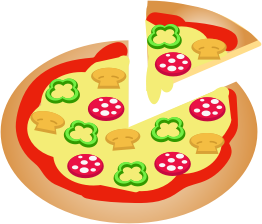
Cut a pizza into 10 slices and eat 5 of them: you have eaten
\frac{5}{10}, which is \frac{50}{100} = 50\%.
Eat just one slice and you have eaten 10\%. The pizza never has
100 slices, but the percentage still works — it measures your share as if the
whole were 100.
The two percentage traps to remember:
- 100% is the WHOLE, not "a hundred things". 100% of your 6 sweets is
all 6 of them — not 100 sweets. The percentage tells you the share, not a count.
- 50% means half of whatever the total is. 50% of 8 is 4; 50%
of 200 is 100. The same "50%" gives different numbers because the wholes are different
sizes.
See it explained
Sal Khan unpacks what "per cent" really means — per hundred — from the ground up.