Halves and Quarters
Imagine you have one whole pizza
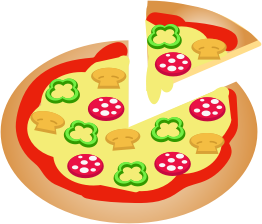 and you want to share it fairly with a friend. How do you cut it? You cut it
right down the middle, so both pieces are exactly the same size. Each
of you gets one of those pieces. Each piece has a special name: a half.
and you want to share it fairly with a friend. How do you cut it? You cut it
right down the middle, so both pieces are exactly the same size. Each
of you gets one of those pieces. Each piece has a special name: a half.
Cut a whole into 2 equal pieces and one of those pieces is a half.
Grown-ups sometimes write it as \tfrac{1}{2}, but for now the word is all
you need: half.
There is one rule that matters more than anything else in this whole page, so let's
say it loudly: the two pieces have to be THE SAME SIZE. If one slice is huge and the
other is a crumb, that is not a half — it's just an unfair share. Keep that rule in your
head, because it comes back again and again.
Watch it get cut
Step through the pizza below. First it's whole. Then it gets cut into 2 equal pieces — a half.
Then one of those halves gets cut again, making 4 equal pieces in total — a
quarter. The little numbers next to the shaded slice show how many pieces are shaded
out of how many equal pieces there are altogether.
Half of a half is a quarter
Try this with a real square of paper — or even a sandwich! Fold it exactly in half: you now have
2 equal pieces, two halves. Now fold it in half again, the same
way. Unfold it, and count the pieces the creases have made: there are 4 of them,
all exactly equal. Each one of those small pieces is a quarter.
That's the secret of a quarter: it's what you get when you cut a whole into 4 equal
pieces — or, just as easily, when you take a half and cut it in half again.
Because you've made more pieces from the same whole, each quarter piece is smaller
than a half piece.
 Break a cookie into 2 equal pieces and one piece is a half. Break each of those pieces in half again,
and now you have 4 equal pieces — each one is a quarter.
Break a cookie into 2 equal pieces and one piece is a half. Break each of those pieces in half again,
and now you have 4 equal pieces — each one is a quarter.
The single biggest trap with halves and quarters: cutting something into two pieces does
not automatically give you two halves — only if the pieces are the same
size.
 If you cut yourself a giant slice of cake and leave your friend a tiny crumb, you might be tempted
to call your big slice "my half" — but it isn't one. It's just one of two unequal pieces,
and that isn't a fair share at all. A half is always two pieces the same size; a
quarter is always four pieces the same size. No exceptions!
If you cut yourself a giant slice of cake and leave your friend a tiny crumb, you might be tempted
to call your big slice "my half" — but it isn't one. It's just one of two unequal pieces,
and that isn't a fair share at all. A half is always two pieces the same size; a
quarter is always four pieces the same size. No exceptions!
A half is bigger! It sounds odd, because 4 is a bigger number than 2 — but think
about the pizza again. Cutting it into 2 pieces makes 2 big pieces. Cutting the
very same pizza into 4 pieces means you had to cut it up smaller, so each
quarter is a skinnier slice than each half. The more equal pieces you cut a whole
into, the smaller each piece gets.
Halves and quarters of a group
Halves and quarters aren't just for shapes — you can share out a group of things
too. Imagine 8 juicy apples
 . First,
count them to
check there really are 8. Now share them equally between 2 friends: deal them out
one at a time, one to each friend, until they're all gone. Each friend ends up with
4 apples — that's a half of the group.
. First,
count them to
check there really are 8. Now share them equally between 2 friends: deal them out
one at a time, one to each friend, until they're all gone. Each friend ends up with
4 apples — that's a half of the group.
What if 4 friends want to share those same 8 apples? Deal them out one at a time to
each of the 4 friends and each one gets 2 apples — that's a quarter
of the group. Just like with the pizza, the golden rule still applies: every friend's pile must have
the same number in it, or it isn't a fair half or quarter.
Here's a fresh pile of sweets to share every time you press Refresh. Watch how the total splits
evenly between the friends:
You've now learned to find a half (2 equal parts) and a quarter (4 equal parts) — of a shape, and of
a whole group of things. Later on you'll meet fractions with other numbers of equal
parts too — thirds, fifths, eighths — and learn to write them properly with the two stacked numbers.
For now, halves and quarters are your starting point:
Fractions
is waiting for you when you're ready.