Imagine one pizza and two hungry friends. How do you share it fairly? You cut it
straight down the middle into two pieces that are exactly the same size, and
each friend takes one. Each friend gets one half of the pizza. That "one half"
is a fraction — and fractions are simply how we talk about part of a
whole when sharing fairly.
A fraction is what you get when you take a whole, split it into
equal parts, and keep some of them. The word "equal" is the heart of it: the pieces
must all be the same size, or it isn't a fair share at all.
We write a fraction as one number stacked over another:
\frac{m}{n}
The bottom number, n, is the denominator — it
counts how many equal parts the whole was split into. (Think: d for
denominator, d for down below, and how many pieces we cut down
into.) The top number, m, is the numerator — it
counts how many of those parts we actually take. So \frac{3}{4}
means three of four equal parts.
Splitting a whole into equal parts is really just
division — sharing the
whole out fairly — so a fraction and a division are two views of the same idea.
The same fraction, three different pictures
A fraction isn't tied to one shape. \frac{1}{2} can be drawn in lots
of ways — and they all mean the same thing: one of two equal parts.
-
A bar. A chocolate bar snapped into two equal pieces; colour one in. One of
two equal pieces is \frac{1}{2}.
-
A circle (a pizza or a cake). A pizza cut into two equal slices; eat one
slice and you've eaten \frac{1}{2} of the pizza.
-
A set of objects. A fraction can even be part of a group. Look at
these six apples:
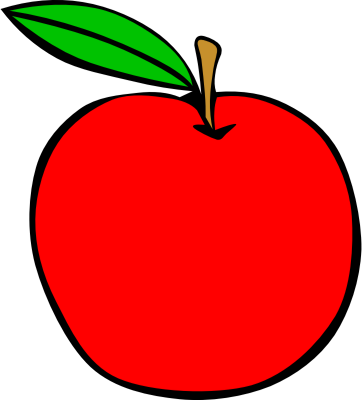
There are 6 apples in all (that's the denominator), and if 2
of them are yours (that's the numerator), then you have
\frac{2}{6} of the apples. Bars, circles, groups — the idea is always
"how many of how many equal parts."
A few worked examples
-
Cut a whole into 2 equal parts and take 1:
\frac{1}{2} — one half.
-
Cut a whole into 4 equal parts and take 3:
\frac{3}{4} — three quarters.
-
Cut a whole into 5 equal parts and take 2:
\frac{2}{5} — two fifths.
Notice the pattern: the bottom tells you the size of each piece (how many it was cut
into), and the top tells you how many of those pieces you grabbed.
The two traps that catch everyone with fractions:
-
The parts must be EQUAL. If you snap a chocolate bar into a big bit and a
tiny bit, the big bit is not "one half" — it's just one of two
unequal pieces, and that isn't a fair fraction at all.
-
A bigger bottom number means SMALLER pieces. The more pieces you cut the
whole into, the tinier each piece must be. So
\frac{1}{8} \lt \frac{1}{4} — an eighth is smaller than a
quarter, even though 8 is bigger than 4!
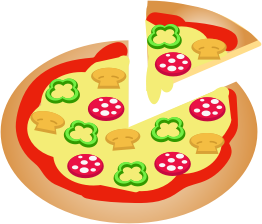
No — and this surprises almost everyone! Take two identical pizzas. Cut the first into
4 slices and grab one: that's \frac{1}{4}. Cut the
second into 8 slices and grab one: that's
\frac{1}{8}. The 8 looks like the "bigger" number, but to make
eight slices you had to cut each one smaller. So
\frac{1}{8} is the smaller slice. More pieces means each
piece shrinks.
Imagine sharing a birthday cake with a friend and cutting yourself a huge piece and them a
crumb. You'd both say one piece each — but it isn't fair, so it isn't really
"halves". A fraction only works when every part is exactly the same size. That's the whole
point of fractions: a fair share. If the parts aren't equal, you can't name
them with a clean fraction.
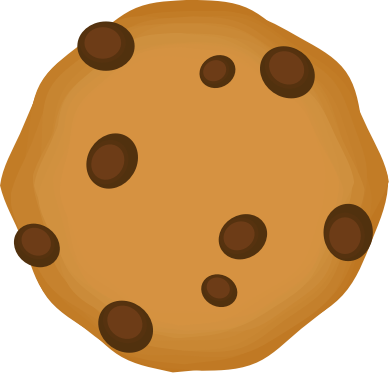
Yes! Break a cookie into 4 equal bits and take 2 of them —
that's \frac{2}{4}. But look at what's in your hand: it's exactly
half the cookie. So \frac{2}{4} = \frac{1}{2}. Different
numbers, same amount. Lots of fractions are secretly the same size — they're just cut into
different numbers of pieces.