Equivalent Fractions
A recipe calls for half a cup of milk, but the only scoop you can find is a quarter-cup — so
you use two of them. Half a cup and two quarter-cups are the same amount of milk: they are
equivalent fractions, the same quantity wearing a different name.
Two fractions are equivalent when they show the
same amount — they just slice the whole into a different number of pieces.
Half a bar is half a bar whether you call it one piece out of two or two pieces out
of four:
\frac{1}{2} = \frac{2}{4} = \frac{3}{6}
Every one of those covers exactly the same length of bar. If you already know what a
fraction is — a count
of equal parts of a whole — then equivalent fractions are simply different
names for one and the same amount. The number on top counts how many parts
you take; the number on the bottom says how many parts the whole was cut into. Change
both together in the right way and the picture is identical.
Same point, same length
There are two pictures that make equivalence obvious. The first is a bar.
Shade half of it. Now draw an extra line down the middle of every piece. You did not rub
out any colour, so the same length is still shaded — but where the bar used to read "1 of
2", it now reads "2 of 4". Nothing about the amount moved; only the number of
cuts changed.
The second is a number line from 0 to 1. Mark the halfway point and call
it \tfrac{1}{2}. Now squeeze in finer tick marks for quarters,
and that very same spot is also labelled \tfrac{2}{4}. Add even
finer ticks for sixths and the same dot becomes \tfrac{3}{6}.
One point on the line, many names:
\frac{1}{2} = \frac{2}{4} = \frac{3}{6} = \frac{4}{8} = \frac{5}{10} = \dots
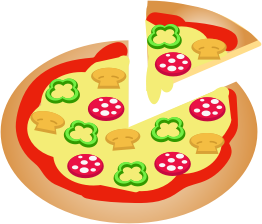
Imagine a pizza cut into two big halves and you take one half. Now the chef slides a
knife across the middle and turns those two halves into four quarters — you are holding
the same food, but suddenly it is two of the four slices. You did not lose or
gain a single bite: \frac{1}{2} = \frac{2}{4}. Cutting more
slices never changes how much pizza there is, only how it is described.
The rule
To make an equivalent fraction, multiply the top and the bottom by the same
number. You are cutting every piece into the same number of smaller pieces, so you end up
with more slices but exactly the same shaded length:
\frac{1}{2} = \frac{1 \times 2}{2 \times 2} = \frac{2}{4}
\qquad \frac{1}{2} = \frac{1 \times 3}{2 \times 3} = \frac{3}{6}
It works in reverse too: divide the top and bottom by the same number and you
glue the small pieces back into bigger ones. The key is that the top and bottom always
change together by the same factor — that is the whole secret, and it is
what keeps the amount the same.
Three worked examples
1. Build up. Turn \tfrac{2}{3} into sixths.
The bottom goes from 3 to 6, which is times 2, so do the same on top:
\frac{2}{3} = \frac{2 \times 2}{3 \times 2} = \frac{4}{6}
2. Build up further. Write \tfrac{3}{4} with a
denominator of 12. From 4 to 12 is times 3:
\frac{3}{4} = \frac{3 \times 3}{4 \times 3} = \frac{9}{12}
3. Simplify down. Go the other way with \tfrac{6}{8}.
Both 6 and 8 divide by 2:
\frac{6}{8} = \frac{6 \div 2}{8 \div 2} = \frac{3}{4}
Simplest form
When you cannot divide the top and bottom by any common number bigger than 1, the fraction
is in its simplest form (also called lowest terms). It is the
tidiest name for that amount. To get there, keep dividing top and bottom by a shared factor
until none is left:
\frac{8}{12} = \frac{8 \div 2}{12 \div 2} = \frac{4}{6}
= \frac{4 \div 2}{6 \div 2} = \frac{2}{3}
Both \tfrac{8}{12} and \tfrac{2}{3}
mark the same point on the number line, but \tfrac{2}{3} uses the
smallest numbers — there is nothing left that divides into both 2 and 3. That is as simple
as it gets.
The most common slips with equivalent fractions:
- Do the same thing to the top and the bottom. Doubling only the top
changes the amount: \frac{1}{2} \neq \frac{2}{3} — that is a
bigger fraction, not an equal one.
- Multiply or divide, never add. Adding 1 to top and bottom gives
\frac{1}{2} versus \frac{2}{3} —
again not equal. Only multiplying or dividing keeps the value.
- Cutting more pieces does not change how much you have. Six small
slices of half a cake is the same cake as one big half — more cuts, same amount.
You promise a friend \tfrac{1}{2} of a cake. Then four people
turn up, so you cut the cake into eighths and hand your friend
\tfrac{4}{8}. Have you cheated them? Not at all —
\frac{4}{8} = \frac{1}{2}, so they get exactly the half you
promised, just served as four little pieces instead of one big one. Equivalent fractions
are how we keep a share fair no matter how finely we slice it.
See it built
Two bars of exactly the same length. The top bar shows
\frac{m}{n}; the bottom bar splits every part into smaller pieces
to show an equivalent fraction. Watch the shaded length stay exactly the same as
the number of pieces grows. Step through it, and press Refresh for a fresh
pair.
See it explained
Sal Khan shows how the same amount of pizza can be cut into different numbers of slices.