Decimals
A bottle of juice says 1.5 litres, a runner is timed at
9.8 seconds, and a chocolate bar costs £0.75. All of these
use numbers with a little dot in them — decimals — because whole numbers
alone are too clumsy for measuring and money. Decimals let us write the bits in
between the whole numbers.
Place value
tells us that each digit is worth ten times the one to its right: hundreds,
tens, ones. Every step left makes a column ten times bigger; every step
right makes it ten times smaller. Decimals just keep that same pattern
going past the ones — we mark where the whole part ends with a
decimal point, and the digits after it count smaller and smaller
pieces of one.
The first digit after the point is tenths — one of ten equal
slices of a whole, which is exactly a
fraction:
0.1 = \frac{1}{10}
So 0.3 means three of those slices —
three tenths:
0.3 = \frac{3}{10}
See it: a strip of ten
Picture one whole as a long bar cut into ten equal parts. Each
little part is one tenth, 0.1. Shade three of them and
you have shaded 0.3 — three tenths of the whole bar:
We can see a tenth as a step on a number line. Cut the gap from
0 to 1 into ten equal
steps; each little step is one tenth. Press play, then replay it: each time the
marker hops along to a new tenth and reads the decimal aloud.
Reading a decimal like 3.7
The point is a fence: whole part on the left, part of one on the right.
In 3.7 the 3 is three whole
ones, and the 7 is seven tenths — seven of those little
slices:
3.7 = 3 + \frac{7}{10}
We say it "three point seven" — read the whole number, say "point", then read the
digits after it one at a time. So 3.7 sits seven tenths
of the way between 3 and 4 on
the number line.
Take one more step right and each tenth splits into ten again. The second digit
after the point is hundredths — one of a hundred equal pieces of
a whole:
0.01 = \frac{1}{100}
Reading left to right, the places after the point go tenths, then hundredths. So
0.27 is two tenths and seven hundredths:
0.27 = \frac{2}{10} + \frac{7}{100}
A handy way to see hundredths is a hundred grid: one whole square
cut into a 10 by 10 grid of 100 little squares. One little square is one
hundredth, 0.01; one whole row of ten is one tenth,
0.1.
See it: shade a hundred grid
Each shaded little square is one hundredth. Count the squares and read the decimal.
Press Refresh to shade a new amount.
Money is decimals you use every day
A pound is split into 100 pennies — just like a whole split into a
hundred hundredths. So a price like \pounds 3.70 means
3 whole pounds and 70 pennies. The 7 is
seven tenths of a pound, which is 70p, and the 0 after it
says "no extra pennies".
\pounds 3.70 = 3 \text{ pounds} + \frac{70}{100} \text{ of a pound}

Prices always show two digits after the point —
\pounds 2.50, not \pounds 2.5 —
because the smallest coin is one penny, which is one hundredth of a pound.
The tenths digit counts the ten-penny pieces and the hundredths digit counts the
single pennies. So \pounds 2.50 is 5 ten-penny pieces and
0 pennies — fifty pence.
Three worked examples
-
0.6 — six tenths. Six of the ten slices of one whole:
0.6 = \frac{6}{10}. More than a half, since a half is
five tenths.
-
2.4 — two whole ones and four tenths:
2.4 = 2 + \frac{4}{10}. It sits between
2 and 3, closer to
2.
-
0.05 — no tenths and five hundredths:
0.05 = \frac{5}{100}. The 0 in
the tenths place is a real worker — it keeps the 5 in the
hundredths place, so this is much smaller than 0.5.
Two traps that catch nearly everyone:
-
More digits does not mean bigger. 0.5
is a half, and it is bigger than
0.45 — even though 0.45 has more digits. Line them up
by place: 0.5 has 5 tenths, 0.45 has only 4
tenths, and the tenths column decides first.
-
The first place after the point is tenths, not "oneths". The
ones live on the left of the point; on the right the pieces are smaller
than one, so they start at tenths.
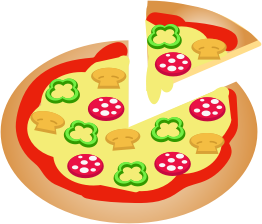
Slice a pizza into ten equal pieces. One slice is one tenth of the pizza,
0.1. Eat three slices and you have eaten
0.3 of it; seven slices is 0.7.
Eat all ten and you are back to one whole pizza,
1.0 — the tenths rolled up into one, just like ten ones
roll up into a ten.
Khan Academy introduces decimals here: